
No Relief for Contractors in Biker Death Case Due to Uncovered Road Pit: Delhi HC
Contractors denied bail in biker death case as Delhi High Court holds safety obligations in road works cannot be ignored.
In a significant decision emphasising accountability in public infrastructure works, the Delhi High Court refused anticipatory bail to contractors accused of the death of a young motorcycle rider who fell into an uncovered excavation pit on a public road. The Court held that contractors entrusted with public works cannot evade responsibility by blaming subcontractors or citing technical defences when gross negligence leads to loss of life.The judgment in Himanshu Gupta v. State of NCT of...
In a significant decision emphasising accountability in public infrastructure works, the Delhi High Court refused anticipatory bail to contractors accused of the death of a young motorcycle rider who fell into an uncovered excavation pit on a public road. The Court held that contractors entrusted with public works cannot evade responsibility by blaming subcontractors or citing technical defences when gross negligence leads to loss of life.
The judgment in Himanshu Gupta v. State of NCT of Delhi (2026), underscores that public roads must remain safe for citizens and that contractors executing public projects bear a non-delegable duty to ensure adequate safety measures.
Background of the Case
The case arose from FIR No. 35/2026 registered at Police Station Janakpuri, Delhi, relating to offences under Sections 105, 238(b), 9(2), and 3(5) of the Bharatiya Nyaya Sanhita (BNS), 2023.
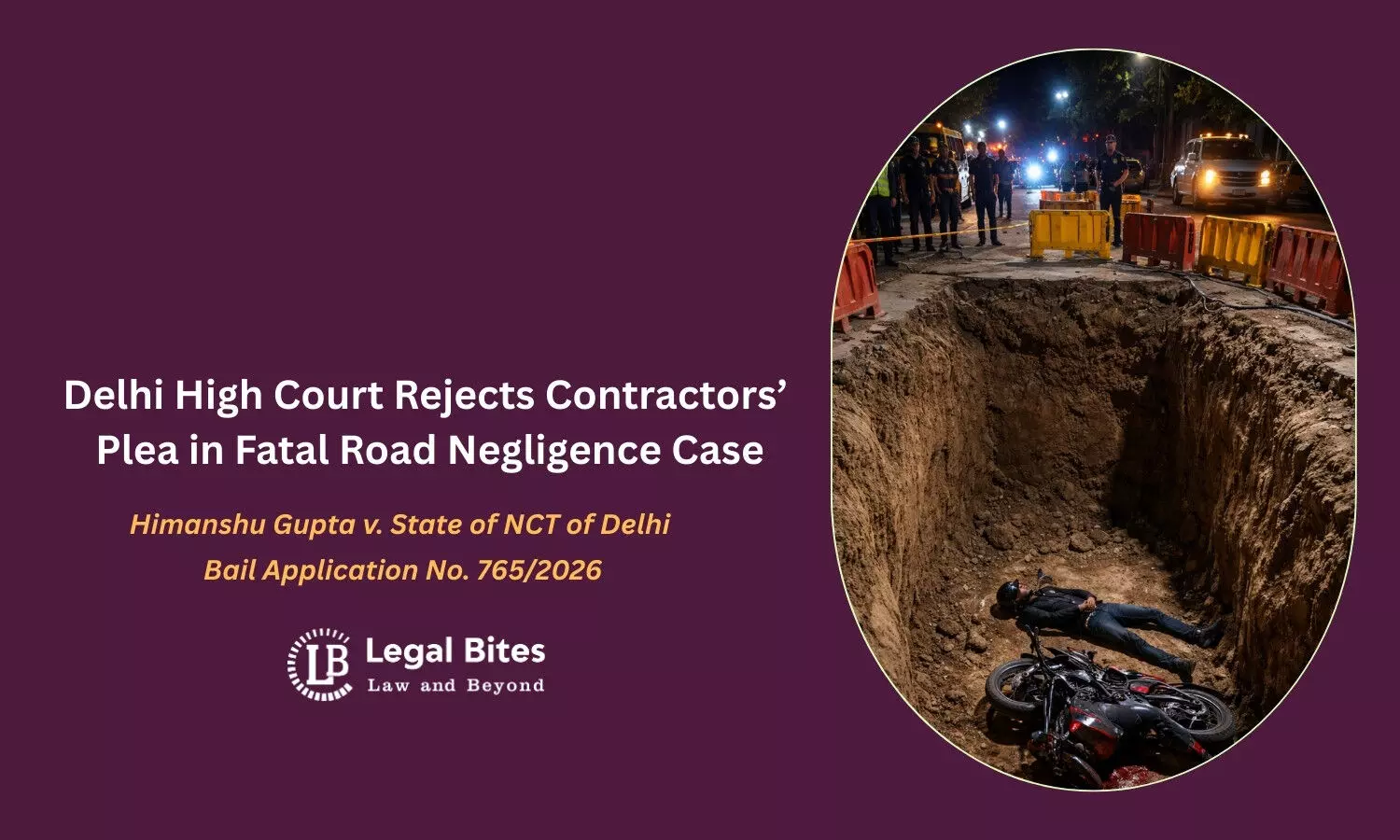
On 6 February 2026, a PCR call informed the police that a motorcycle rider had fallen into a deep excavation pit located near Andhra School in Janakpuri. Police reached the site and discovered a young man along with his motorcycle inside a large pit measuring approximately 20 feet in length, 13 feet in width, and 14 feet in depth, which had been dug in the middle of the road.
The pit had been excavated as part of sewer rehabilitation work undertaken by the Delhi Jal Board (DJB). Despite rescue efforts, the victim was declared dead at Deen Dayal Upadhyay Hospital.
Allegations Against the Contractors
The Delhi Jal Board had awarded a work order for sewer rehabilitation to a joint venture led by M/s K.K. Spun Indian Limited (KKSIL). The petitioners were directors of the company.
According to the prosecution:
- The work had been subcontracted to another contractor.
- No safety measures were installed at the excavation site.
- There were no warning signs or barricades.
- No caution boards or safety lights were present.
- The excavation remained open on a public road.
CCTV footage allegedly showed that:
- No precautionary measures existed before the accident.
- Barricades were placed only after the incident.
- The subcontractor informed the main contractor shortly after the accident.
The prosecution also argued that instead of helping the victim, the contractors attempted to conceal the site by installing barricades after the accident.
Contractors’ Defence
The contractors sought anticipatory bail on several grounds:
1. Suspension as Directors
They argued that they had been suspended as directors pursuant to an order of the National Company Law Tribunal (NCLT) and therefore had no operational control over the company during the relevant period.
2. Lack of Direct Involvement
The applicants claimed that:
- The work was approved after their suspension.
- They were not involved in day-to-day operations.
- They had no responsibility for safety measures.
3. Bailable Offence Argument
It was also argued that:
- The offence alleged under Section 105 BNS was not made out.
- At most, Section 106 BNS (causing death by negligence), a bailable offence, would apply.
Court’s Analysis
The Delhi High Court rejected the defence and held that the contractors could not escape liability merely by citing subcontracting arrangements or technical defences.
Contractor’s Non-Delegable Duty
The Court carefully examined the contractual conditions and found that certain obligations could not be delegated.
The contract specifically provided that the contractor must personally perform:
- Project management
- Planning
- Monitoring
- Quality assurance
Subcontracting was permitted only with prior approval from the Delhi Jal Board. No such approval had been obtained in this case.
The Court held that:
Subcontracting cannot absolve the contractor of responsibility for safety at the project site.
Safety Obligations Ignored
The contract imposed strict safety obligations, including:
- Installation of caution boards
- Proper barricading
- Warning signs
- Rescue equipment
- First-aid arrangements
- Adequate lighting
- Watch and ward arrangements
The contractor was also made absolutely responsible for accidents occurring during the execution of the work.
Despite these requirements:
- The excavation remained open.
- No safety measures existed.
- No emergency equipment was available.
The Court concluded that basic precautions were completely absent.
Violation of Traffic Permissions
The Delhi Traffic Police had granted permission for excavation work subject to strict conditions, including:
- Night-time work only (10 PM to 6 AM)
- Proper barricading
- Warning signs
- Safety lights
- Safe pedestrian passage
However:
- Excavation was carried out during the day.
- The accident occurred at night.
- Safety measures were missing.
- These violations demonstrated clear negligence.
Active Role of Contractors
The Court rejected the argument that the contractors had no operational control.
Evidence showed:
- The contractors remained in communication with the subcontractor.
- Instructions were issued by the contractors.
- Company officials confirmed receiving directions from them.
- They corresponded with DJB even after alleged suspension.
The Court held that these facts contradicted their claim of non-involvement.
Failure to Assist the Victim
One of the most serious observations made by the Court concerned the conduct of the accused after the accident.
The Court noted that:
- The contractors were informed about the accident.
- No police report was filed.
- No medical assistance was arranged.
- Barricades were installed after the accident.
The Court described this conduct as shocking and indicative of disregard for human life.
Preventable Death
The Court strongly observed that the incident was not a mere accident but a preventable tragedy.
The Court stated that negligence was evident from the facts and circumstances and that:
When a deep pit is dug in the middle of a busy road without safety measures, an untoward incident is inevitable.
The Court emphasised that contractors cannot treat such incidents as routine accidents.
Public Roads and Public Duty
The judgment stressed that public roads belong to citizens and must remain safe. The Court observed that when a contractor undertakes work on public roads, the contractor assumes a public duty.
It held that:
- Citizens have a legitimate expectation of safe roads.
- Contractors must ensure safety.
- Excavation work creates foreseeable risks.
The Court concluded that the duty to ensure safety was non-delegable.
Criminal Liability of Contractors
The Court clarified that criminal liability was not being imposed merely because the applicants were directors.
Instead, liability arose from:
- Contractual obligations
- Operational involvement
- Failure to ensure safety
- Failure to assist the victim
- Violation of permissions
The Court also held that insolvency proceedings do not protect individuals from criminal liability.
Need for Custodial Interrogation
The Court noted that the investigation was still ongoing and several aspects required further inquiry:
- Execution of subcontract before award of main contract
- Missing documents
- Safety approvals
- Communication records
Custodial interrogation was considered necessary to uncover the full facts.
Refusal of Anticipatory Bail
The Delhi High Court ultimately refused anticipatory bail. The Court held that:
- A young life had been lost due to gross negligence.
- Evidence was still being collected.
- Bail could hamper the investigation.
- Public interest required strict scrutiny.
The Court warned that leniency would send a dangerous message and encourage irresponsible execution of public works.
Conclusion
The Delhi High Court’s decision in the biker death case serves as a stern reminder that public infrastructure projects must be executed responsibly and safely. The Court made it clear that contractors entrusted with public works cannot escape accountability by shifting blame or relying on technical defences.
The judgment emphasises that the lives of ordinary citizens cannot be treated as collateral damage of development activities. When contractors undertake work on public roads, they assume a legal and moral duty to ensure safety.
By refusing anticipatory bail to the accused contractors, the Delhi High Court has reinforced the principle that negligence resulting in loss of life must be treated with seriousness and accountability under the law.
Important Link
Law Library: Notes and Study Material for LLB, LLM, Judiciary, and Entrance Exams

Lakshay Anand
Lakshay Anand is a Legal & Property Consultant in Himachal Pradesh, specializing in Real estate, dispute resolution, and environmental law. An advocate by profession, he holds an LL.M. in Intellectual Property Law and a Postgraduate Diploma in Tourism and Environment Laws from National Law University, Delhi.