
Do Prisoners Have a Right to Regular Medical Check-Ups? Madras High Court Explains
Madras High Court holds prisoners entitled to periodic medical check-ups under Article 21 and directs regular health screening in prisons.
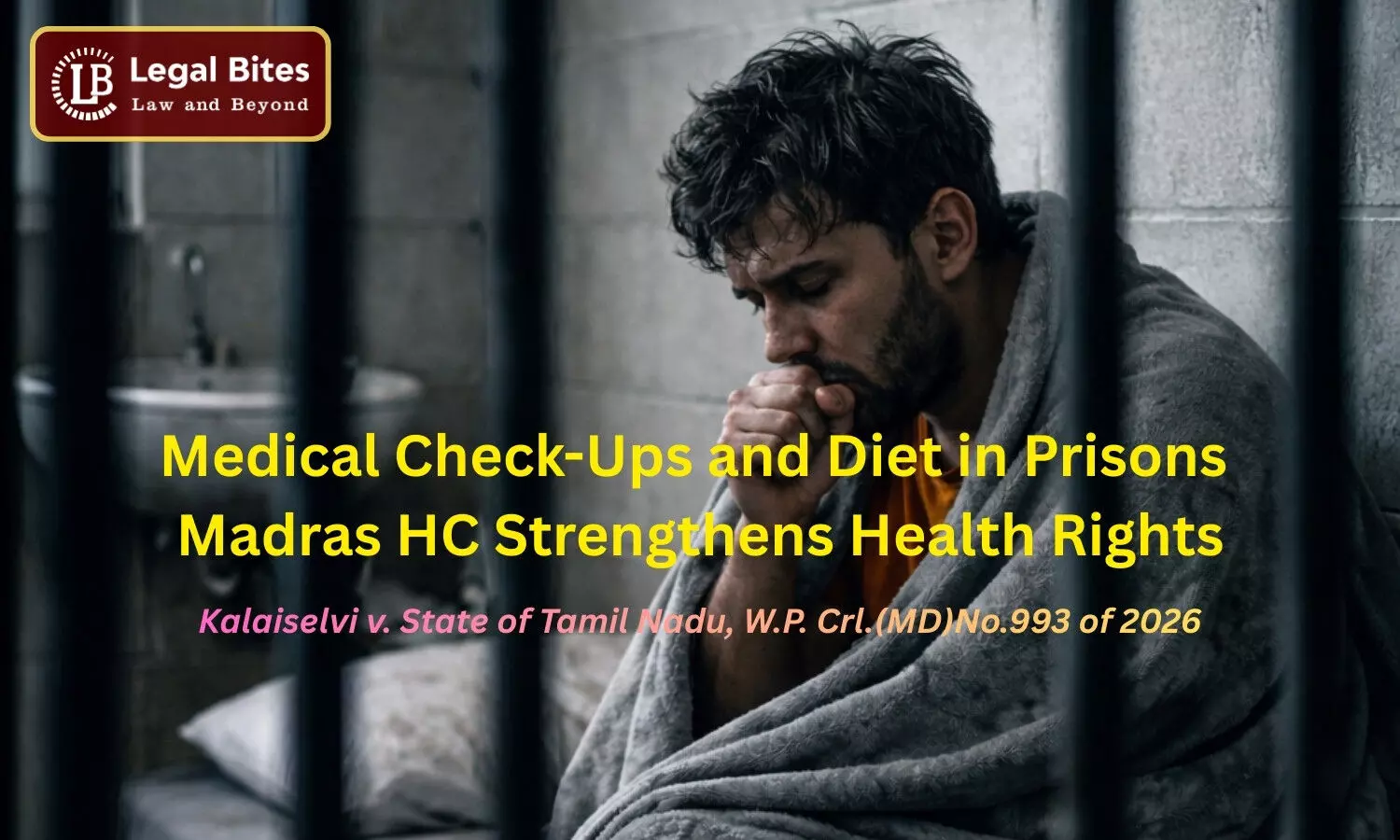
The right to health and medical care forms an essential component of the right to life and human dignity under Article 21 of the Constitution of India. This constitutional protection extends not only to free citizens but also to prisoners, who remain under the State's complete custody and control. In Kalaiselvi v. State of Tamil Nadu (2026), the Madras High Court (Madurai Bench) examined the scope of prisoners’ entitlement to periodic medical care. It emphasised the obligation of...
The right to health and medical care forms an essential component of the right to life and human dignity under Article 21 of the Constitution of India. This constitutional protection extends not only to free citizens but also to prisoners, who remain under the State's complete custody and control. In Kalaiselvi v. State of Tamil Nadu (2026), the Madras High Court (Madurai Bench) examined the scope of prisoners’ entitlement to periodic medical care. It emphasised the obligation of prison authorities to ensure proper health monitoring.
The Court held that every prisoner is entitled to regular medical examinations as part of the constitutional guarantee under Article 21 and directed prison authorities to conduct comprehensive health check-ups for all inmates once every two years. The judgment highlights the State’s duty to provide adequate healthcare and reasonable accommodation to prisoners, especially those suffering from disabilities or chronic illnesses.
The ruling strengthens prison jurisprudence in India by affirming that incarceration does not deprive a person of basic human rights, particularly the right to healthcare and dignified living conditions.
Background of the Case
The writ petition was filed by M. Kalaiselvi, seeking ordinary leave for her father, Murugesan, a life convict lodged in Central Prison, Palayamkottai. The prisoner had undergone right-leg amputation due to complications arising from diabetes, and the petitioner sought 28 days’ leave without police escort under the Tamil Nadu Suspension of Sentence Rules, 1982.
Murugesan had spent more than six years in prison and had recently undergone surgery due to serious medical complications.
While deciding the leave request, the Court expanded the scope of the proceedings and examined broader issues relating to medical care and disability rights of prisoners.
Issue Before the Court
The key legal issue was:
- Whether prisoners have a constitutional right to periodic medical check-ups and appropriate medical care under Article 21 of the Constitution.
The Court also considered:
- State obligations toward prisoners with disabilities
- Need for early medical diagnosis in prisons
- Provision of an appropriate diet and treatment
- Requirement of regular health monitoring
Constitutional Basis of Prisoners’ Health Rights
The Madras High Court held that periodic medical check-ups fall within the scope of Article 21, which guarantees the right to life and personal liberty.
The Court observed:
"We hold that every prisoner has a right to have a periodical medical check up which would fall within the scope of Article 21 of the Constitution of India."
This principle is consistent with earlier Supreme Court jurisprudence recognising that prisoners retain fundamental rights except those necessarily curtailed by incarceration.
The Court emphasised that prisoners remain entirely dependent on prison authorities for their healthcare needs, thereby imposing a higher duty on the State.
Importance of Early Medical Diagnosis
A major concern highlighted by the Court was the failure of early diagnosis, which resulted in the prisoner’s leg amputation.
The Court noted that:
- The prisoner developed complications due to diabetes.
- Proper diagnosis and treatment could have prevented amputation.
- Adequate diet and medical intervention were lacking.
The Court observed:
If the condition had been diagnosed well in advance and suitable medical intervention had been provided, such a fate might have been avoided.
This observation underscores the preventive function of prison healthcare.
Directions for Regular Medical Check-Ups
One of the most significant directions issued by the Court was:
- Master health check-up for all prisoners once in two years
The Court directed:
The Superintendent of Central Prison, Palayamkottai shall hold a master health check-up for all prisoners once in two years.
This direction recognises systematic health monitoring as a necessary component of prison administration.
Regular medical examinations help:
- Identify chronic diseases
- Prevent serious complications
- Provide timely treatment
- Improve prison health standards
Health Rights of Prisoners with Disabilities
The judgment draws extensively from the Supreme Court decision in L. Muruganantham v. State of Tamil Nadu (2025), which laid down guidelines for prisoners with disabilities.
The Supreme Court had directed that:
- Prisoners with disabilities must be identified at admission.
- Accessible infrastructure must be provided.
- Physiotherapy and therapy facilities must be available.
- Healthcare equivalent to community standards must be ensured.
The Madras High Court applied these principles and held that reasonable accommodation is mandatory.
The Court observed:
Reasonable accommodations are not optional but integral to a humane and just prison system.
Right to Appropriate Diet
The Court emphasised that prisoners must receive medically suitable diets.
It noted that:
- Diabetic prisoners need special diets
- Patients with renal problems require low-salt food
- Diet must match individual health conditions
The Court stated that:
Jail authorities are obliged to provide diet suitable to the unique body condition of each prisoner.
The Court also directed that diabetic prisoners should be given sugar-free tea or coffee and appropriate food.
Medical Camps and Screening
The Court directed the Government Medical College and Hospital, Tirunelveli to:
- Conduct medical camps
- Identify diabetic prisoners
- Provide medicines and insulin where necessary
This direction reflects a proactive approach toward prison healthcare.
Special Facilities for Disabled Prisoners
The Court issued several directions to improve living conditions for the amputee prisoner:
Facilities Ordered
The prisoner was to be provided:
- Cot and table
- Western toilet or commode facility
- Wheelchair or crutches if required
- Counselling and rehabilitation
- Accessible housing block
These directions demonstrate the practical application of disability rights in prisons.
Role of Prison Authorities
The Court emphasised that prison authorities have a positive duty of care.
Since prisoners are under State control:
- Authorities must ensure medical care
- Authorities must monitor health
- Authorities must prevent deterioration of health
The Court observed that prisoners are entirely dependent on prison administration and therefore deserve special protection.
Reasonable Accommodation under RPwD Act
The Court relied on the Rights of Persons with Disabilities Act, 2016, which introduced the concept of reasonable accommodation.
The Court held that:
- Prisoners with disabilities are entitled to reasonable accommodation.
- This obligation applies equally inside prisons.
- Failure to provide accommodation violates fundamental rights.
The Court clarified that prisoners may enforce these rights through writ petitions.
Human Dignity and Prison Conditions
The judgment strongly emphasised human dignity.
The Court noted that prison conditions should be:
- Humane
- Inclusive
- Accessible
- Compassionate
It is observed that incarceration does not reduce a prisoner’s status as a human being.
Conclusion
The Madras High Court's decision in Kalaiselvi v. State of Tamil Nadu (2026) represents a major step forward in prison reform jurisprudence. The Court clearly affirmed that prisoners have a fundamental right to periodic medical check-ups and appropriate healthcare under Article 21 of the Constitution.
By directing regular health examinations, specialised treatment, and appropriate diet, the Court emphasised that incarceration cannot justify neglect of basic human needs. The judgment reinforces the principle that prisoners remain rights-bearing individuals whose dignity must be preserved even behind prison walls.
The ruling sends a strong message that a humane prison system must be built on compassion, medical care, and constitutional accountability, ensuring that punishment does not become neglect or suffering.
Important Link
Law Library: Notes and Study Material for LLB, LLM, Judiciary, and Entrance Exams

Mayank Shekhar
Mayank is an alumnus of the prestigious Faculty of Law, Delhi University. Under his leadership, Legal Bites has been researching and developing resources through blogging, educational resources, competitions, and seminars.