
Is Encroachment on Public Streets Permissible for Religious Purposes?
Public streets cannot be encroached upon for religious purposes; the rule of law prevails over faith-based claims.
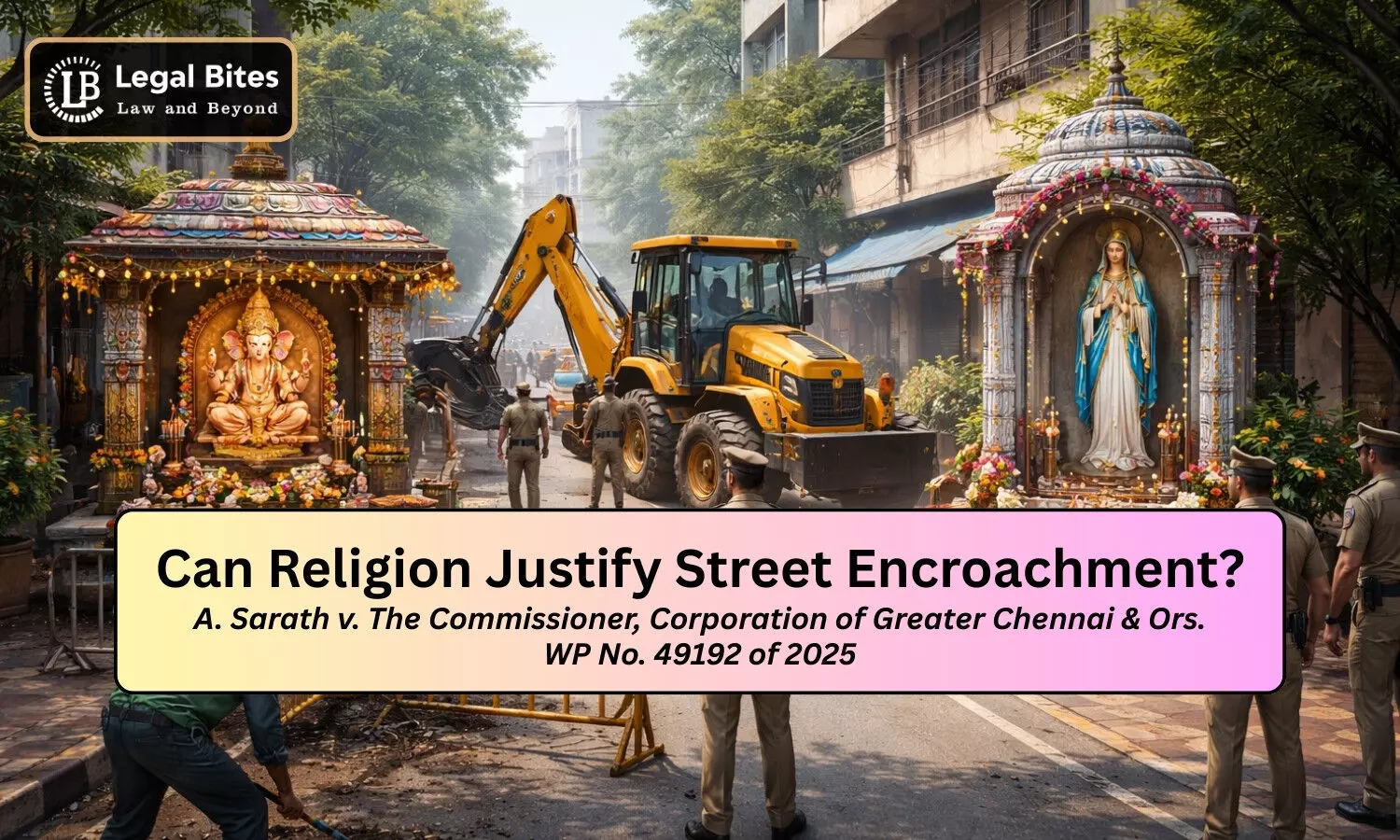
The Madras High Court, in A. Sarath v. The Commissioner, Corporation of Greater Chennai & Ors., delivered a significant judgment reiterating the absolute illegality of religious encroachments on public roads and footpaths, irrespective of their antiquity or the religious sentiments attached to them. The Court firmly held that Article 25 of the Constitution does not protect unauthorised religious structures on public land, and that municipal authorities have a statutory duty to remove...
The Madras High Court, in A. Sarath v. The Commissioner, Corporation of Greater Chennai & Ors., delivered a significant judgment reiterating the absolute illegality of religious encroachments on public roads and footpaths, irrespective of their antiquity or the religious sentiments attached to them. The Court firmly held that Article 25 of the Constitution does not protect unauthorised religious structures on public land, and that municipal authorities have a statutory duty to remove such encroachments under Section 128 of the Tamil Nadu Urban Local Bodies Act.
Facts of the Case
A. Purchase of Property by the Petitioner
The petitioner, A. Sarath, purchased a residential property bearing Door No. 1, Andal Avenue 1st Street, Thiru. Vi. Ka. Nagar, Chennai – 600 082, through a registered sale deed dated 25 November 2024. Prior to purchase, he inspected the premises and noticed a temporary structure near the entrance, which he was informed would be removed in due course.
B. Discovery of Religious Structure
After commencing repairs and preparations for a housewarming ceremony, the petitioner discovered that:
- A statue of Mother Mary (Velankanni) had been installed in the said structure.
- A pillar with an amplifier had been erected.
- Electricity was illegally drawn from a house across the street.
- The structure obstructed the main entrance to his property.
- It also blocked pedestrian movement on the public pavement.
The petitioner alleged that the structure was a clear encroachment on a public road, causing nuisance and inconvenience to the public at large.
C. Representation to Authorities
On 13 September 2025, the petitioner submitted a written complaint to the Greater Chennai Corporation requesting the removal of the illegal structure. Though the complaint was acknowledged, no action was taken, compelling the petitioner to approach the High Court under Article 226 of the Constitution seeking a writ of mandamus.
Procedural History
- The writ petition sought a direction to the municipal authorities to act on the complaint dated 13.09.2025.
- On 19 December 2025, the Court directed the Corporation to inspect the site after Christmas and New Year celebrations.
- During proceedings, Mr. R. Daniel sought impleadment, claiming responsibility for establishing and maintaining the shrine.
- He was impleaded as Respondent No. 3 by order dated 21 January 2026.
- The matter was finally heard on 22 January 2026.
Issues Before the Court
- Whether a religious structure erected on a public road can be protected on the grounds of long-standing existence and religious sentiment.
- Whether Article 25 of the Constitution protects unauthorised religious structures on public land.
- Whether municipal authorities are bound to remove such encroachments under Section 128 of the Tamil Nadu Urban Local Bodies Act.
- Whether the allegations raised by the third respondent against the petitioner could be examined in the present writ petition.
Court’s Analysis and Reasoning
A. Nature of the Land and Encroachment
The Court found, based on official records, that:
- The land was classified as Sarkar Poramboke – Street.
- The shrine was undeniably constructed on a public road.
- No private ownership rights were claimed by the third respondent.
The Court emphasised that public roads do not acquire religious character merely because a religious structure is placed upon them.
B. Religious Freedom Under Article 25
The Court categorically rejected the plea that Article 25 of the Constitution protects unauthorised religious structures erected on public streets. Relying on the Supreme Court’s decision in Union of India v. State of Gujarat (2009), as well as consistent views taken by the Karnataka and Allahabad High Courts, the Court reaffirmed that freedom of religion does not extend to illegal occupation of public land.
Division Bench of the Karnataka High Court in W.P. No. 46839 of 2019, dated 14-07-2020, wherein Chief Justice Abhay Oka (as he then was) held as follows:
"The fundamental right under Article 25 of the Constitution of India does not extend to offering worship or prayer at each and every place. Surely, the fundamental right under Article 25 of the Constitution of India cannot be invoked for protecting an illegal structure of a temple which is situated on a footpath. The right to construct an unauthorised temple, that too on a footpath, cannot be said to be an essential part of any religion or religious practice which can be protected under Article 25 of the Constitution of India."
C. Long Standing Encroachment is No Defence
Rejecting the argument of antiquity, the Court held that:
- Illegality does not ripen into legality by passage of time.
- Every moment of encroachment constitutes a fresh cause of action.
- Long existence cannot defeat the statutory obligations of public authorities.
Thus, the plea that the shrine existed for 30 years was held to be irrelevant in law.
D. Statutory Duty Under Section 128
The Court explained the scope of Section 128(1)(b) of the Tamil Nadu Urban Local Bodies Act:
- It imposes a mandatory duty on the Commissioner to keep public streets free from encroachments.
- A seven-day notice is sufficient.
- Nature of the structure, whether religious or otherwise, is immaterial.
The notice dated 19 January 2026 was found to be fully compliant with the law.
E. Undertaking Filed by the Third Respondent
Though Mr. Daniel expressed an inability to remove the idol single-handedly, he undertook to remove the structure within three weeks. The Court held that:
- Having admitted to installing and maintaining the shrine, he could not disclaim responsibility.
- His undertaking did not nullify statutory proceedings already initiated.
F. Allegations Against the Petitioner
The Court refused to examine allegations of perjury and illegal activities made against the petitioner, holding that:
- They were extraneous to the issue of encroachment.
- Mr. Daniel was free to pursue independent legal remedies.
Conclusion
The Madras High Court’s ruling in A. Sarath v. Corporation of Greater Chennai is a decisive reaffirmation that public roads belong to the public, not to encroachers, irrespective of faith or history. By placing statutory duty, constitutional discipline, and civic order above emotional appeals, the Court has strengthened both urban rule of law and constitutional secularism, setting a clear benchmark for similar disputes across India.
Important Link
Law Library: Notes and Study Material for LLB, LLM, Judiciary, and Entrance Exams

Lakshay Anand
Lakshay Anand is a Legal & Property Consultant in Himachal Pradesh, specializing in Real estate, dispute resolution, and environmental law. An advocate by profession, he holds an LL.M. in Intellectual Property Law and a Postgraduate Diploma in Tourism and Environment Laws from National Law University, Delhi.