
Sixth Pay Commission Benefits Cannot Be Withheld from Panchayat Employees
MP High Court rules Sixth Pay Commission benefits, once granted to Panchayat employees, cannot be denied or recovered arbitrarily by the State.
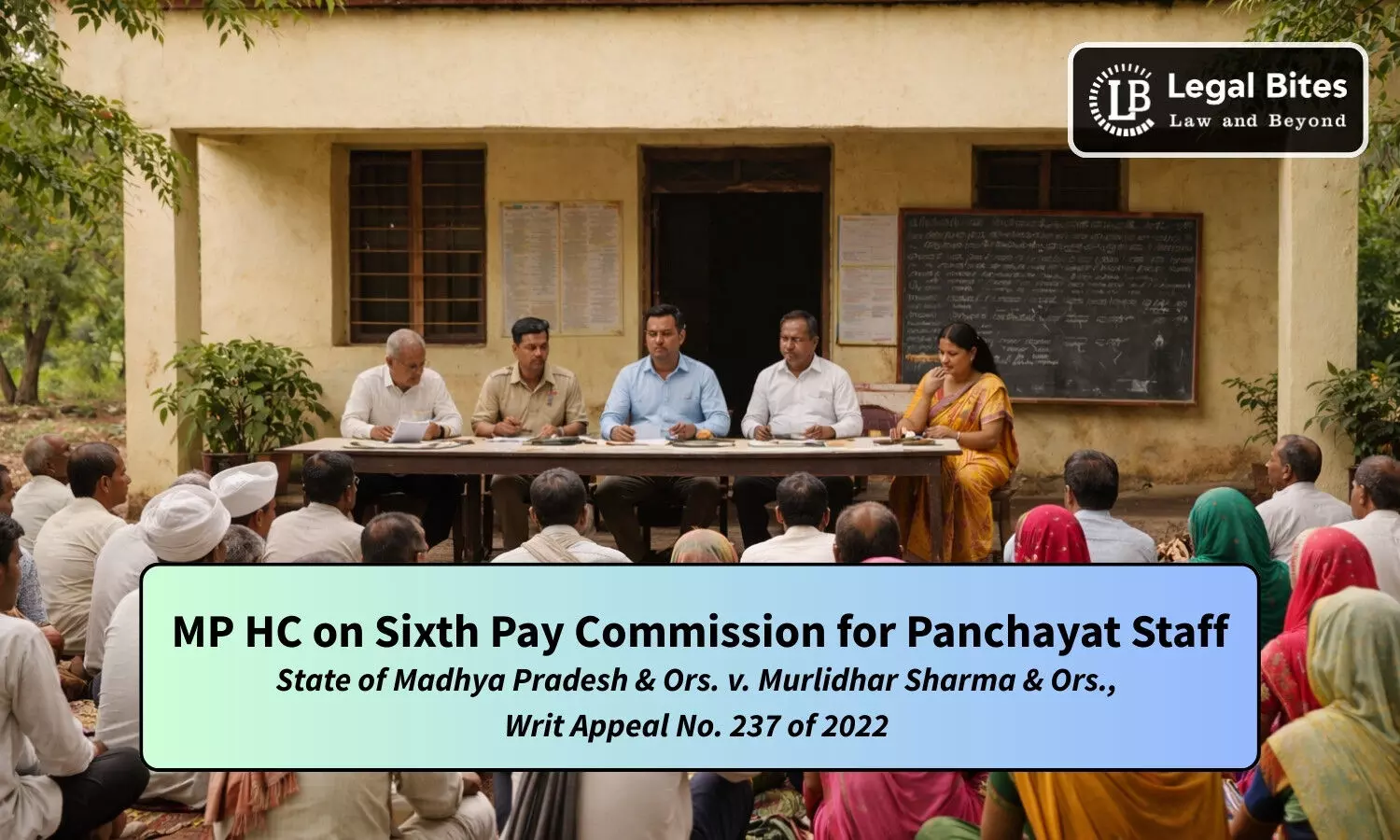
In a significant ruling strengthening service protections for employees of local self-government institutions, the Madhya Pradesh High Court (Indore Bench) in State of Madhya Pradesh & Ors. v. Murlidhar Sharma & Ors., Writ Appeal No. 237 of 2022 (decided on 15 January 2026), held that Sixth Pay Commission benefits, once granted to Panchayat employees, cannot be arbitrarily withdrawn or subjected to recovery. Dismissing the State’s appeal, the Division Bench reaffirmed that...
In a significant ruling strengthening service protections for employees of local self-government institutions, the Madhya Pradesh High Court (Indore Bench) in State of Madhya Pradesh & Ors. v. Murlidhar Sharma & Ors., Writ Appeal No. 237 of 2022 (decided on 15 January 2026), held that Sixth Pay Commission benefits, once granted to Panchayat employees, cannot be arbitrarily withdrawn or subjected to recovery. Dismissing the State’s appeal, the Division Bench reaffirmed that employees of Gram Panchayat, Janpad Panchayat, and Zila Panchayat cannot be discriminated against in matters of pay revision solely on the ground that Panchayats are financially dependent on the State.
The judgment addresses a long-standing controversy concerning the parity of Panchayat employees with State Government employees in the implementation of Pay Commission recommendations and reinforces constitutional principles of equality, non-arbitrariness, and equal pay for equal work, while also recognising the autonomous status of Panchayati Raj Institutions under Part IX of the Constitution of India.
Background of the Dispute
The respondents in the case were employees of the Zila Panchayat, Indore, working under the Panchayat and Rural Development Department of the State of Madhya Pradesh. Initially, the State Government issued a circular dated 21 July 2010, granting Fifth Pay Commission benefits to Panchayat employees with retrospective effect from 1 January 2006. Subsequently, in meetings and administrative decisions taken in 2009, the benefit of the Sixth Pay Commission was also extended to them from 1 April 2006.
However, the State later issued orders dated 2 March 2010 and 18 April 2011, directing that Sixth Pay Commission benefits granted to Panchayat employees be withdrawn and recovered. Acting upon these instructions, the Chief Executive Officer of the Zila Panchayat ordered the recovery of amounts already paid, without issuing any show-cause notice or granting an opportunity of hearing to the employees.
Aggrieved, the employees approached the High Court by filing Writ Petition No. 7834 of 2011, which was allowed by the Single Judge. The recovery orders were quashed. Challenging this decision, the State preferred Writ Appeal No. 237 of 2022, leading to the present judgment.
Issue
The Division Bench framed the core issue as:
- Whether employees of Gram Panchayat, Janpad Panchayat, and Zila Panchayat are to be treated at par with State Government employees in respect of the date of implementation of the Sixth Pay Commission recommendations.
Arguments Advanced by the State
The State contended that Panchayats are independent bodies with no independent source of revenue and are fully dependent on grants-in-aid from the State Government. Consequently, Panchayat employees could not be equated with State Government employees for pay parity.
It was argued that Panchayat institutions fall within the category of semi-government organisations, and therefore, employees working therein cannot automatically claim benefits identical to those extended to State Government servants. According to the State, the extension of Sixth Pay Commission benefits was erroneous, and its subsequent withdrawal was merely corrective in nature.
Stand of the Employees
The respondents argued that Panchayats are constitutional institutions of self-government under Part IX of the Constitution, and not private or contractual bodies. Once the competent employer authority had consciously extended Sixth Pay Commission benefits, the State could not arbitrarily reverse the decision or order recovery, particularly when employees had neither misrepresented facts nor played any role in the alleged error.
It was also contended that the selective implementation of pay revision dates amounted to hostile discrimination and violated Article 14 of the Constitution.
Constitutional Status of Panchayats: The Court’s Analysis
The Court undertook a detailed examination of Articles 243B to 243O, highlighting that Panchayats are constitutionally recognised institutions of self-government, vested with authority, responsibilities, and financial powers as conferred by State legislatures.
Importantly, the Court observed that while Panchayats receive financial assistance from the State, they are not mere extensions of the State Government. Their autonomy flows directly from the Constitution, and their employees cannot be treated as inferior or dispensable merely because of fiscal dependence.
The Bench further clarified that Article 309, which empowers the State to regulate service conditions of persons appointed to public services in connection with State affairs, does not extend to Panchayat employees, unless expressly authorised by law. Therefore, the State Government lacked the competence to unilaterally fix a different date for implementing Pay Commission benefits for Panchayat employees without statutory backing.
Equal Pay for Equal Work: A Reaffirmation
The High Court placed heavy reliance on settled Supreme Court jurisprudence on the doctrine of “Equal Pay for Equal Work”, referring to landmark decisions such as:
- Randhir Singh v. Union of India (1982)
- Surinder Singh v. Engineer-in-Chief, CPWD (1986)
- State of Punjab v. Jagjit Singh (2017)
The Bench reiterated that where employees discharge identical duties against sanctioned posts, denial of equal pay or differential treatment in pay revision dates constitutes arbitrary classification violative of Articles 14 and 16 of the Constitution.
In the present case, Panchayat employees were performing functions comparable to their counterparts in State departments. Hence, fixing a later date (1 April 2013) for implementing Sixth Pay Commission benefits for them, while State employees received it from 1 January 2006, was held to be unreasonable, discriminatory, and constitutionally impermissible.
Illegality of Recovery Orders
A crucial aspect of the judgment relates to the recovery of excess payments. The Court held that salary already paid pursuant to a lawful administrative decision cannot be recovered in the absence of:
- Fraud
- Misrepresentation
- Suppression of material facts
- Any fault attributable to the employee
The respondents had merely received a salary as fixed by the employer. Ordering recovery years later, without notice or hearing, was not only procedurally flawed but also substantively unjust.
Relying on principles of fairness and settled service law, the Court directed that any recovery already made must be refunded with 6% interest, recognising that employees had structured their lives and finances around the salary lawfully paid to them.
Financial Constraints Cannot Override Constitutional Rights
The State’s argument of financial hardship was unequivocally rejected. The Court held that financial constraints cannot be used as a justification for violating constitutional guarantees or denying legitimate service benefits. Welfare legislation and beneficial service measures must be interpreted purposively, particularly when they affect livelihood and dignity.
The Bench emphasised that administrative convenience or fiscal stress cannot legitimise discrimination or the arbitrary withdrawal of vested rights.
Final Decision
Dismissing the writ appeal, the Madhya Pradesh High Court held:
- Grant of Sixth Pay Commission benefits to Panchayat employees was legal and valid.
- Withdrawal and recovery of such benefits were arbitrary, discriminatory, and unconstitutional.
- Panchayat employees are entitled to pay revision from the same date as State Government employees, unless lawfully differentiated.
- Any recovery already effected must be refunded with interest.
Conclusion
The Madhya Pradesh High Court’s decision in State of Madhya Pradesh v. Murlidhar Sharma & Ors. stands as a robust affirmation of constitutional values in the law of service. By holding that Sixth Pay Commission benefits cannot be withheld from Panchayat employees, the Court has reinforced that decentralised governance under Part IX must operate within the broader framework of equality, dignity, and fairness.
Ultimately, the ruling reminds State authorities that once the State chooses to confer a benefit, it cannot be withdrawn arbitrarily, and that Panchayat employees are not second-class public servants but integral participants in India’s constitutional governance structure.

Lakshay Anand
Lakshay Anand is a Legal & Property Consultant in Himachal Pradesh, specializing in Real estate, dispute resolution, and environmental law. An advocate by profession, he holds an LL.M. in Intellectual Property Law and a Postgraduate Diploma in Tourism and Environment Laws from National Law University, Delhi.