
Garbage, Governance and the Right to Life: Supreme Court’s Stand on Solid Waste Management
Supreme Court finds waste mismanagement unconstitutional and orders strict nationwide enforcement to safeguard public health.
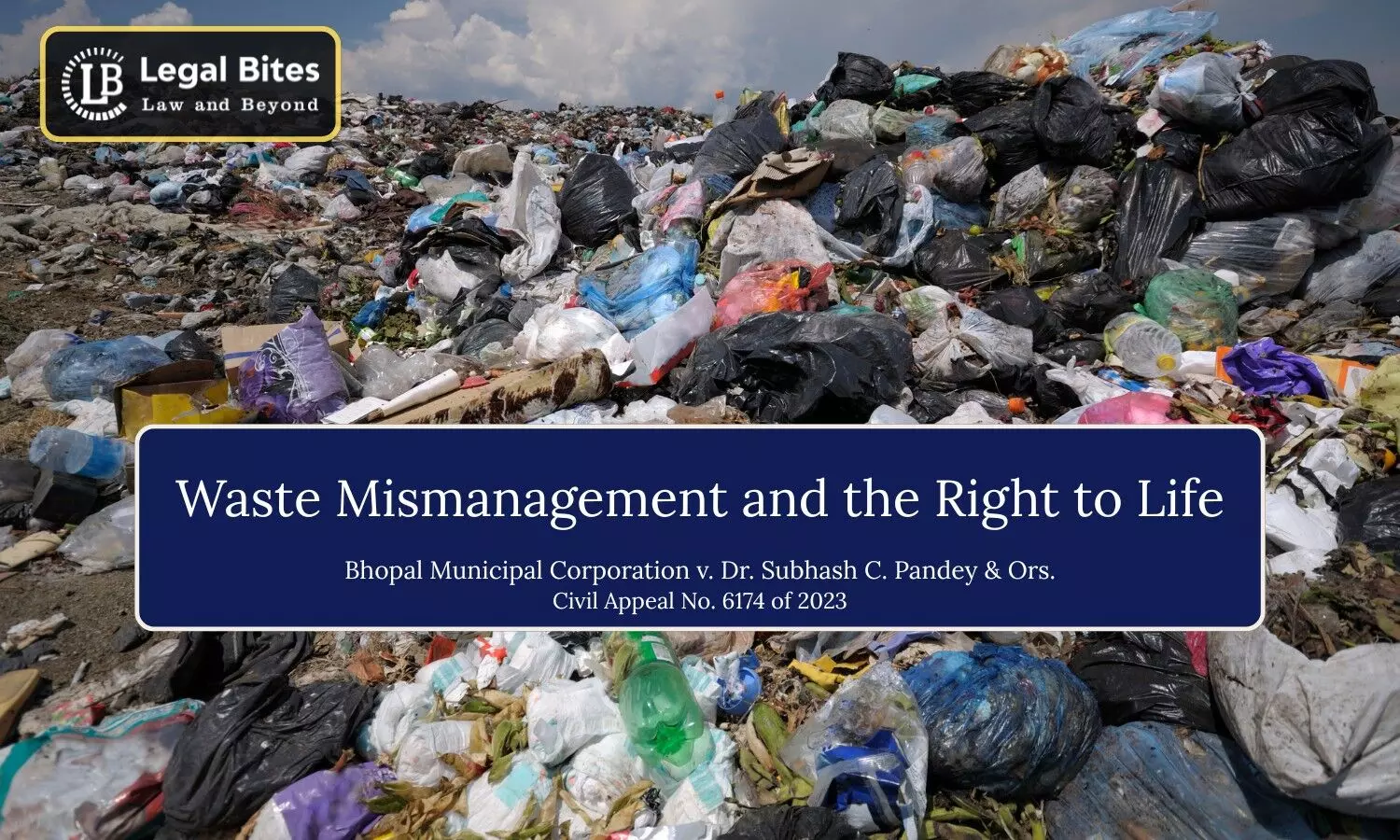
Garbage is no longer a peripheral civic concern; it has emerged as a defining governance challenge of urban India. Overflowing landfills, unscientific dumping, contaminated groundwater, and air pollution from waste burning directly affect public health and environmental sustainability. Recognising this reality, the Supreme Court of India has repeatedly affirmed that environmental protection is inseparable from the Right to Life under Article 21 of the Constitution.
This constitutional position received its most comprehensive articulation in the Court’s landmark order dated 19 February 2026, delivered in Bhopal Municipal Corporation v. Dr. Subhash C. Pandey & Ors., while examining nationwide compliance with solid waste management laws. The judgment goes far beyond dispute resolution. It lays down a national governance framework for waste management, declares non-compliance to be a constitutional failure, and mandates three-tier enforcement, including criminal prosecution.
Facts
The case arose from proceedings before the National Green Tribunal concerning non-compliance by the Bhopal Municipal Corporation with the Solid Waste Management Rules, 2016. The NGT had issued directions requiring scientific collection, segregation, processing, and disposal of municipal solid waste, including remediation of legacy dumpsites.
Aggrieved by these directions, the Bhopal Municipal Corporation filed Civil Appeal No. 6174 of 2023 before the Supreme Court of India, along with a connected appeal. During the proceedings, compliance reports submitted by the State Pollution Control Board revealed only partial adherence to statutory waste management norms.
While hearing the appeals, the Supreme Court took note of the nationwide failure of local bodies to effectively process municipal solid waste and the continued operation of unscientific landfills. The Court also considered the notification of the Solid Waste Management Rules, 2026, scheduled to come into force from 1 April 2026.
Holding that the issue was not confined to Bhopal but reflected a systemic governance problem, the Court issued pan-India directions to ensure effective implementation of the 2026 Rules, linking solid waste management directly with the right to a clean and healthy environment under Article 21 of the Constitution.
Solid Waste Management as a Constitutional Issue
Article 21 and Environmental Protection
Indian constitutional jurisprudence has long recognised that the right to life under Article 21 is not confined to mere animal existence. It includes the right to live with dignity, health, and a clean environment. In the present order, the Supreme Court reiterates in unequivocal terms that:
“The right to a clean and healthy environment is an inseparable part of the Right to Life guaranteed by Article 21 of the Constitution of India.”
This formulation places solid waste management squarely within the realm of fundamental rights enforcement, transforming municipal failures into constitutional violations.
Waste Crisis in India: Judicial Recognition of Ground Reality
Scale of the Problem
Relying on official data from the Central Pollution Control Board, the Supreme Court noted that India generates approximately 1.7 lakh tonnes of municipal solid waste per day. While collection levels have improved in some cities, processing remains the biggest bottleneck, with vast quantities ending up in unscientific landfills and legacy dumpsites.
The Court rejected cosmetic compliance narratives and acknowledged that:
- Segregation at source remains uneven.
- Unprocessed waste disproportionately impacts slums and peri-urban areas.
- Groundwater and air contamination pose long-term public health risks.
This empirical grounding strengthens the Court’s interventionist stance.
Law in Place, Compliance Missing
Justice Pankaj Mithal and Justice S. V. N. Bhatti stated:
"The neglect of municipal solid waste will affect health as much as the economy. Despite the wisdom of the Parliament, after due deliberation and research, creating robust rules, the execution of the MSW/SWM Rules reveals significant gaps. There are varying reasons for the same. The legislature has done its job, and it is now for the executive and the citizens to implement and follow the mandate laid down by the Parliament, and ensure that the rules are implemented in the right way without leaving any time gaps."
Evolution of Solid Waste Management Law in India
From 2000 to 2026: Three Generations of Regulation
The Supreme Court traces the legislative evolution of waste management laws:
Solid Waste Management Rules, 2000
- Focused narrowly on municipal authorities
- Emphasised collection and disposal
Solid Waste Management Rules, 2016
- Expanded applicability to census towns, villages, railways, and airports
- Introduced segregation at source
Solid Waste Management Rules, 2026
- Shift to a digital-first, circular economy framework
- Introduction of Extended Bulk Waste Generator Responsibility (EBWGR)
- Mandated four-stream segregation: wet, dry, sanitary, and special care waste
- Centralised online compliance portal
The Court characterised the 2026 Rules as structurally transformative, aimed at closing historical compliance gaps.
Legal Status of the SWM Rules, 2026
Not Mere Delegated Legislation
A significant doctrinal contribution of the judgment lies in clarifying the legal force of the SWM Rules, 2026. Framed under Sections 3, 6, and 25 of the Environment (Protection) Act, 1986, and laid before Parliament under Section 26, the Court held that:
The Rules are “as good as the will expressed by the Parliament.”
This finding forecloses arguments treating waste rules as optional administrative guidelines and elevates them to a quasi-legislative mandate binding all authorities.
Accountability of the State and Local Governments
Governance Failure, Not Administrative Lapse
The Supreme Court decisively rejected the tendency of authorities to trivialise waste mismanagement as routine inefficiency. It declared that non-compliance will no longer be treated as a mere administrative lapse.
This marks a jurisprudential shift, from advisory environmentalism to coercive constitutional enforcement.
Three-Tier Enforcement Framework
One of the most consequential aspects of the judgment is the introduction of a three-tier enforcement mechanism:
Tier I: Immediate Fines
Monetary penalties for initial non-compliance by individuals, bulk generators, or local authorities.
Tier II: Criminal Prosecution
Continued violations attract prosecution under environmental laws.
Tier III: Personal Liability
Prosecution extends to:
- Officials failing in oversight duties.
- Persons abetting or neglecting statutory obligations.
The Court also mooted the deployment of mobile environmental courts to address violations in real time.
Redefining Local Governance and Democratic Accountability
Elected Representatives as Lead Facilitators
In a striking move, the Court placed direct responsibility on elected representatives- mayors, councillors, corporators, and ward members- to lead source-segregation education within their constituencies.
This approach democratises environmental governance by:
- Linking electoral accountability with environmental outcomes.
- Requiring citizen enrolment through political leadership.
Role of District Collectors and State Machinery
Vertical Integration of Oversight
The judgment empowers District Collectors to:
- Conduct infrastructure audits.
- Oversee compliance across urban and rural local bodies.
- Report non-compliance to state and central authorities.
Chief Secretaries are tasked with ensuring time-bound achievement of 100% compliance, reinforcing administrative hierarchy as an enforcement tool.
Bulk Waste Generators and the Polluter Pays Principle
Extended Bulk Waste Generator Responsibility (EBWGR)
The Court emphasised that bulk waste generators (BWGs), including housing complexes, institutions, and commercial establishments—can no longer externalise waste costs onto municipalities.
Key mandates include:
- Mandatory registration on a central portal.
- On-site wet waste processing or procurement of EBWGR certificates.
- Environmental compensation for failure after 1 April 2026.
- This operationalises the polluter pays principle in everyday urban governance.
Education, Youth, and Cultural Transformation
Recognising that sustainable waste management requires behavioural change, the Court directed:
- Inclusion of solid waste management in school curricula
- State-level student competitions
- Translation of SWM Rules into local languages
- Ward-level dissemination through elected representatives
The directions frame youth participation and civic education as structural pillars of environmental compliance.
Addressing Legacy Waste and Environmental Justice
Ending the Practice of Invisible Dumping
The Supreme Court made a powerful normative statement:
Low-income group areas and slums are not dumping sites for urban waste.
By mandating time-bound action plans for legacy waste remediation, the Court linked waste governance to environmental justice, acknowledging disproportionate harm to vulnerable populations.
Conclusion
The Supreme Court has transformed solid waste management from a routine municipal function into a core element of constitutional governance. By recognising persistent waste mismanagement as a direct threat to the health economy and human dignity, the Court has underscored that the existence of strong laws is meaningless without faithful execution.
The directions place the burden of compliance squarely on governments, local bodies, institutions and citizens alike and signal that environmental neglect will invite legal consequences. This approach reaffirms that the right to life cannot coexist with systemic administrative apathy and that effective waste governance is indispensable to sustainable development and public welfare.