
Supreme Court Halts Deer Translocation, Emphasises Ecology Over Administrative Ease
Supreme Court suspends deer relocation from A.N. Jha Deer Park, calling for scientific review, welfare safeguards and ecological accountability.
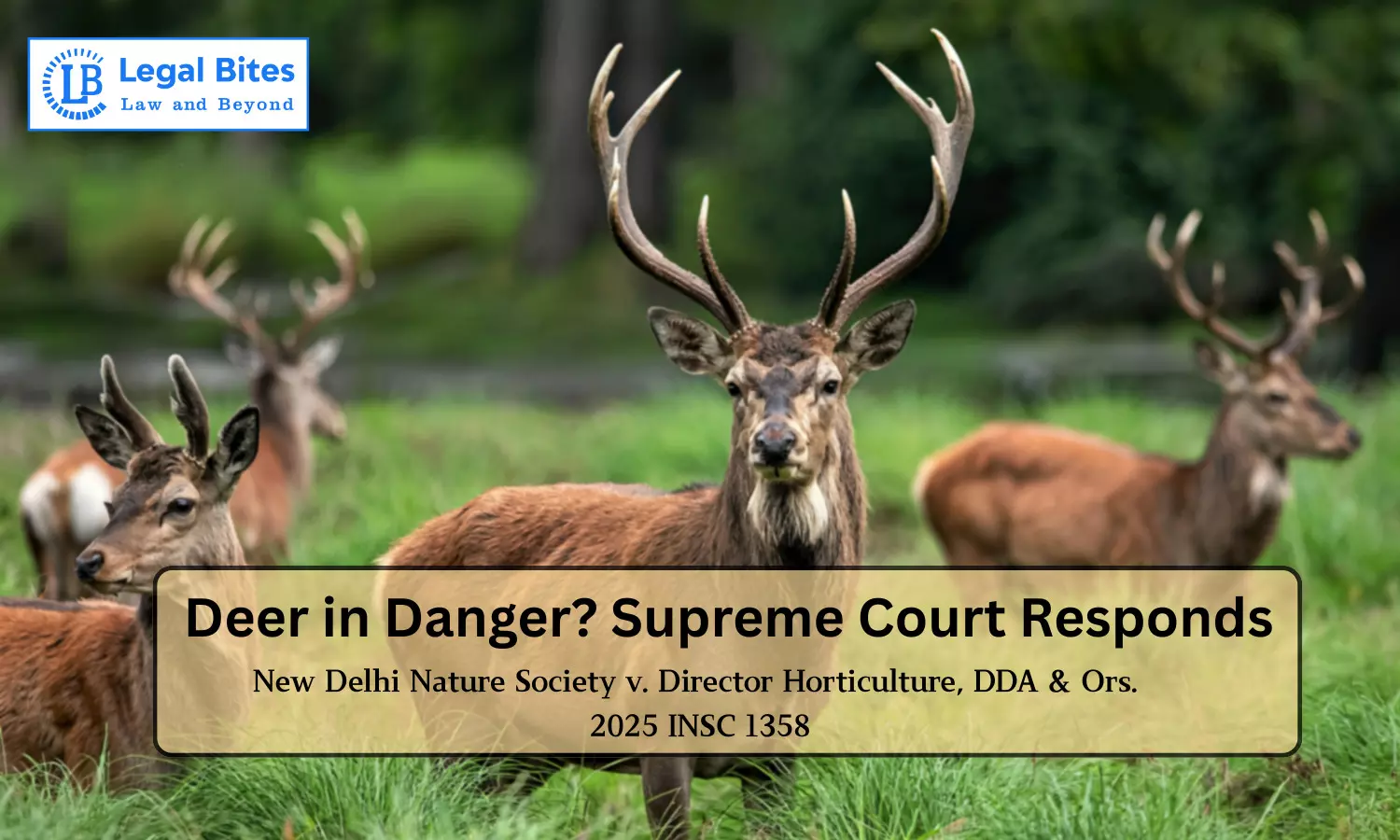
In New Delhi Nature Society v. Director Horticulture, DDA & Ors. (2025 INSC 1358), the Supreme Court of India delivered a significant environmental ruling on 26 November 2025, halting further translocation of deer from the historic A.N. Jha Deer Park, Hauz Khas, New Delhi. The judgment, arising out of a public interest petition filed by New Delhi Nature Society, reaffirmed a core ecological principle — wildlife management must be grounded in scientific necessity rather than administrative convenience.
Background: A Green Oasis Under Administrative Stress
Established in 1968 across nearly 142 hectares of public green space, A.N. Jha Deer Park gradually evolved into one of Delhi’s largest urban wildlife pockets. Deer were introduced decades ago, creating a semi-natural viewing space for residents and children at a time when the city was far less populated. By the 2000s, however, unchecked growth, mismanagement, and poor veterinary supervision turned the sanctuary into a conservation challenge instead of a showcase.
The Central Zoo Authority (CZA) repeatedly flagged:
- Lack of enclosure expansion despite herd growth
- No structured population control or sterilisation
- Negligible segregation of males and females
- Minimal veterinary oversight
Licence suspension in 2014 was a turning point. Recognition was restored conditionally, yet compliance problems persisted for years. In 2021, the licence lapsed again — and instead of upgrading infrastructure, DDA opted to close the deer enclosure entirely and evacuate the herd.
The translocation proposal, however, triggered constitutional and ecological alarm bells, eventually reaching the Supreme Court.
Why Translocation Was Proposed — Science or Simplification?
DDA argued that the park was overcrowded — numbers were believed to be between 350 to 600 deer, beyond what 10.97 acres could support long-term. Overpopulation caused stress, competitive feeding, and high susceptibility to disease outbreaks.
From an administrative lens, relocation appeared simpler than long-term habitat improvement or upgrading veterinary facilities.
But conservation science does not support relocation as a default response to overpopulation. Translocation, the Court stressed, is a last resort, permissible only after exhaustive ecological evaluation and not merely as policy expediency.
Field Evidence: What Triggered Judicial Intervention?
The petitioner NGO produced alarming field findings:
| Allegation | On-ground Observation |
|---|---|
| Massive transport grouping | Trucks reportedly carried up to 40 deer at a time |
| Lack of veterinary supervision | No sedatives, hydration or monitoring ensured |
| No tagging or identification | Impossible to track survival or deaths |
| Juveniles and pregnant deer included | Contrary to IUCN and CZA guidelines |
| Survival at release site unclear | Of 261 deer sent to Rajasthan — only 112-115 sighted |
Bones tied with rope were reportedly found in release areas, raising suspicion that deer may have been used as predator bait. Post-translocation grasslands lacked restored ground cover, water troughs in the Park remained mostly dry, and fodder supplies indicated provision for only around 84 deer, while hundreds were believed present.
The Court found this information grave enough to warrant independent ecological scrutiny.
Supreme Court’s Observations — Animal Welfare Above Everything
A core proposition of the ruling is that wildlife management is not an executive convenience but a responsibility anchored in constitutional and statutory mandates. The Court stressed:
“Wildlife management cannot be approached as a matter of administrative convenience.”
Backed by Articles 21, 48A and 51A(g), the Court emphasised that:
- Every wildlife decision must reflect ecological sensitivity.
- Relocation must be scientifically researched, not hastily executed.
- Captive animals have the same inherent right to welfare as wild populations.
- State authority is not absolute over sentient beings.
The judgment reinforces evolving environmental jurisprudence, which recognises wildlife as community trusteeship rather than state property.
Conclusion
The Supreme Court’s halt on deer translocation is not merely a restraint order — it is a constitutional environmental milestone. It recognises wildlife not as passive administrative units but as sentient beings entitled to dignity, ecological protection and humane management.
The judgment amplifies a profound environmental ethic:
Conservation is not relocation.
Conservation is responsibility, science and compassion.
By demanding ecological assessments, welfare-based translocation protocols and accountability against official negligence, the Court has strengthened India’s wildlife governance framework and reminded all authorities that biodiversity cannot be managed through shortcuts.
In an era where cities grow, forests shrink, and ecological conflicts intensify, this ruling stands as a judicial reminder that development must be reconciled with stewardship — not at the cost of life, but in service of it.
Important Link
Law Library: Notes and Study Material for LLB, LLM, Judiciary, and Entrance Exams