
Comparative Study of Strike and Lockout Laws in India, the UK, and the USA
Read this comparative article on strike and lockout laws in India, the UK, and the USA, examining legal frameworks, procedures, and key judicial rulings.
This article provides a comparative analysis of the laws governing strikes and lockouts in India, the UK, and the USA, aiming to enhance readers' understanding of how these nations manage industrial actions. The article delineates the legal frameworks in each country, emphasising the procedures that both workers and employers must adhere to in order to execute a lawful strike or lockout. Additionally, it explores how each nation reconciles workers' rights with the necessity for...
This article provides a comparative analysis of the laws governing strikes and lockouts in India, the UK, and the USA, aiming to enhance readers' understanding of how these nations manage industrial actions. The article delineates the legal frameworks in each country, emphasising the procedures that both workers and employers must adhere to in order to execute a lawful strike or lockout. Additionally, it explores how each nation reconciles workers' rights with the necessity for industrial tranquillity.
Significant judicial rulings are examined to elucidate how the courts have interpreted the legality of strikes and lockouts, as well as the entitlements of workers during conflicts. Through the examination of these three countries, the article offers a lucid perspective on how laws safeguard workers while ensuring industrial continuity, thereby assisting readers in acquiring a practical understanding of labour law within these jurisdictions
Concept of Strike and Lockout
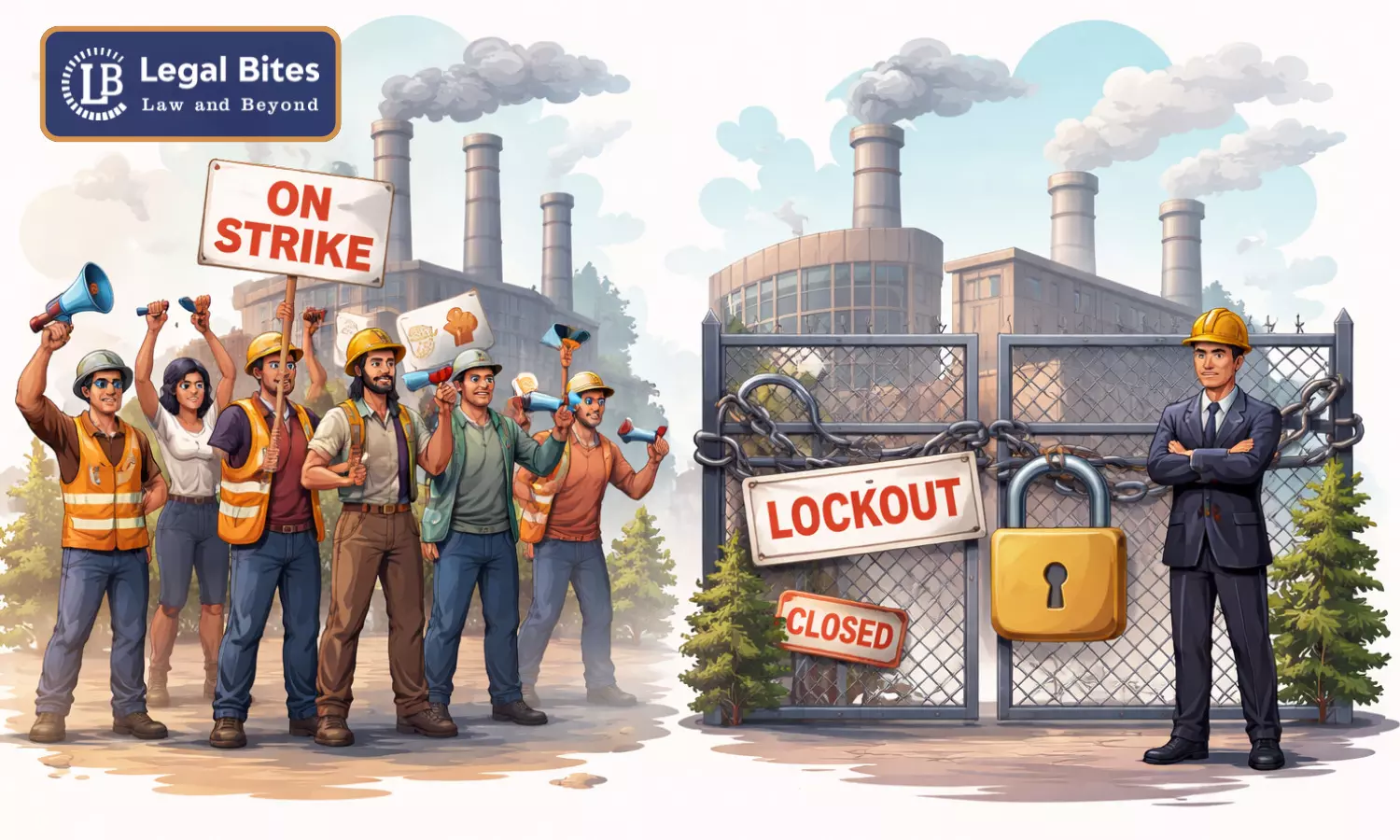
Strike refers to a concerted cessation of work by employees to secure improved wages and working conditions or to gain a right. Lockout refers to the temporary closure of a workplace or prevents the workers from doing work during the period of a dispute. Both strikes and lockouts are important components of industrial relations, as they represent mechanisms through which conflicts are managed between workers and employers.
The subject is specifically applicable in today’s society, such as the strike by bank employees for demanding a five-day work week in 2026.
Legal Framework of Strike and Lockout in India
Strikes and lockouts are essential features of industrial relations. It reflects the conflict of interest between labour and capital. The Constitution of India also protects certain fundamental freedoms, but the right to strike is not an express right. The legislature has to strike a balance, ensuring workers’ rights and upholding industrial peace through the Industrial Disputes Act, 1947 (IDA), court pronouncements, and constitutional interpretations.
The Industrial Disputes Act, 1947 is the primary legislation governing strikes and lockouts in India.
- Strike [Section 2(q)] – means “a cessation of work by a body of persons employed in any industry acting in combination” or a concerted refusal to continue to work or accept employment.
- Lockout [Section 2(l)] – means the temporary closing of a place of employment or suspension of work or refusal by an employer to continue to employ any person employed by him.
Legal Requirements for Strikes and Lockouts
The Act provides clear distinctions between lawful and unlawful industrial action, specifically in respect to the public utility and non-public utility application areas:
Lawful Strikes/Lockouts (Sections 22 & 23)
- Notice period must be provided (6 weeks) for public utility services.
- No strike or lockout occurring during the conciliation process, or seven days from the conclusion of those proceedings.
- No strike action while adjudication is pending before a Labour Court, Tribunal or National Tribunal.
- Not acting contrary to existing settlements or awards.
Unlawful Strikes/Lockouts (Section 24)
- Any strike or lockout that transgresses Sections 22 or 23 will be unlawful in nature.
- Active participation in unlawful strike action may result in disciplinary action, loss of pay and potential criminal liability pursuant to Section 26.
Is the Right to Strike a Fundamental Right?
Article 19(1)(c) of the Constitution of India allows the right to form associations or unions. However, Indian constitutional jurisprudence has consistently held that the right to strike is not a fundamental right, nor is it an automatic or implied extension of the right to form associations.
The Supreme Court has clarified that while workers have the freedom to form unions, the methods adopted by such unions to achieve their objectives, including strikes, are subject to statutory regulation.
1. T.K. Rangarajan v. State of Tamil Nadu (2003)
The Supreme Court delivered a landmark ruling whereby it held that a government employee has no right to strike. The Court emphasised that essential services cannot be permitted to come to a halt.
2. Kameshwar Prasad v. State of Bihar (1962)
The Supreme Court struck down the rule banning all demonstrations by government servants as unconstitutional for violating Articles 19(1)(a) and 19(1)(b). It held that government servants enjoy fundamental rights subject to reasonable restrictions. However, the ban on strikes was upheld since there is no fundamental right to strike.
Legal Regulation of Strike and Lockout in the UK
The principal source of law governing strikes and lockouts (and related matters) is the Trade Union and Labour Relations (Consolidation) Act 1992 (TULRA 1992). The Act is the primary body of law governing trade union law, collective bargaining, and industrial action (including strikes and lockouts).
Definition of Strike and Lockout
Section 246 of TULRA 1992 defines a strike as “any concerted stoppage of work by employees.” A lockout is defined as employer action in order to prevent workers from performing their work during an industrial dispute.
Procedure for Undertaking Industrial Action
1. Secret Ballot
Under Sections 226–234A, a union is required to undertake a secret postal ballot of all members of the union who are required to participate in the action.
- Section 227: Only those members who are directly involved in the proposed action can vote.
- Section 229: The vote must be secret, and the result counted fairly.
- Section 231: The results must be communicated to both members and the employer.
2. Voting Results
In terms of the Trade Union Act 2016:
- There needs to be a minimum turnout of 50 per cent of the eligible members voting.
- When it comes to key services (e.g., transport or schools), there must be a minimum of 40% of all eligible members voting ‘yes’.
3. Notice to Employer
Under Section 234A, the union must give the employer 14 days' written notice of the proposed strike, starting on the date and time indicated. The notice must specify:
- The date industrial action will start
- The nature of the action
4. Time Limit
Action must start within 6 months after the voting result under section 233 (can be extended to 9 months by agreement of both parties).
5. Legal Protection
If the union goes through all these steps, the union enjoys the benefits provided under Section 219, which grants immunity from legal proceedings. If the union fails to adhere to these requirements, then the action would become an unlawful one, and the courts may intervene to stop it.
Metrobus Ltd v. Unite the Union (2009)
The Court of Appeal held that section 231A TULRA requires a union to notify the employer of the ballot result at the earliest reasonably practicable time, which Unite failed to do by delaying while considering industrial action. As a result, the strike was unprotected and injunctible, despite the Court disagreeing that a minor numerical error in the strike notice was fatal.
Mercury Communications Ltd v. Scott-Garner (1984)
It was held that industrial action, including strikes, must be linked with a genuine trade dispute to be protected.
Government and Judicial Approach
UK law takes a restrictive approach to strikes. The Courts are extremely strict on procedural points. The UK government only allows strikes within the legal framework because it aims to protect workers without compromising economic stability. Judges generally enforce procedure, rather than stopping industrial action unless there is an essential flaw in procedure.
Legal Regulation of Strike and Lockout in the USA
In the United States, strikes and lockouts are primarily governed by the National Labour Relations Act (NLRA), which was passed in 1935. The NLRA protects workers with regard to their rights to organise, collectively bargain, and engage in concerted activity like a strike. The National Labour Relations Board (NLRB) serves as the agency that enforces the NLRA, including the resolution of disputes between employers and employees.
Right to Strike
The NLRA establishes that employees are entitled to strike; however, not absolutely. Strikes are not considered a constitutional right under the First Amendment; however, courts have acknowledged strikes as a legitimate form of collective economic action linked to freedom of association and collective bargaining.
There are two types of legal strikes:
1. Economic Strike: Workers cease work to obtain better wages, hours, or working conditions. If the strike is an economic strike, employers may permanently replace the workers but must refrain from retaliation or discrimination.
2. Unfair Labour Practice (ULP) Strike: Workers strike, protesting illegal employer action, like an employer failing to bargain in good faith. In these cases, the workers are afforded greater legal protections and the right to reinstatement.
Legal Conditions for Lawful Strikes or Lockouts
For a strike to be lawful under the NLRA (National Labour Relations Act):
- It must be related to collective bargaining.
- Workers are not allowed to use violence, sit-down strikes (meaning the workers are still on the job but not working), or intermittent strikes, which are illegal.
- Secondary boycotts and wildcat strikes (unauthorised by the union) are prohibited under the NLRA.
Employers can also use lockouts as a legal tool, which usually happens if the parties are at an impasse in bargaining. However, these restrictions must be bona fide (good faith) and not to punish workers, and they must be related to labour disputes.
Important Cases
1. NLRB v. Mackay Radio & Telegraph Co. (1938)
The U.S. Supreme Court held that an employer may hire permanent replacement workers during a lawful economic strike. However, the Court emphasised that employers may not discriminate against employees based on union membership
2. NLRB v. Washington Aluminium Co. (1962)
The U.S Supreme Court held that employees who do not belong to a union are still protected by the law, specifically Section 7 of the National Labour Relations Act, when they work together to help each other or protect themselves. A spontaneous walkout protesting unsafe or intolerable working conditions (here, extreme cold in the workplace) can qualify as protected concerted activity, even without union involvement or advance notice. An employer could not lawfully terminate the employees.
Conclusion
The UK and the USA have emphasised the protected status that applies to collective bargaining and worker rights, albeit within a regulated statutory framework. On the contrary, India has closely tied industrial peace and economic productivity, which is often extended at the expense of labour freedoms. Judiciary and extensive statutory regulation have significantly curtailed the practical exercise of the right to strike.
Ultimately, a clear, balanced and reasonable approach to workers’ rights, integrating industrial peace and economic stability, is necessary. Strikes should continue to be a legitimate alternative to protest and must not be looked at as a form of suppressed protest.
References
- National Labour Relations Act, 1935 (USA).
- Industrial Disputes Act, 1947
- Trade Union and Labour Relations (Consolidation) Act 1992
- Constitution of India,1950
- T.K. Rangarajan v. Government of Tamil Nadu, (2003) 6 SCC 581
- Kameshwar Prasad v State of Bihar, AIR 1962 SC 1166
- Metrobus Ltd v. Unite the Union, (2009) EWCA Civ 829
- Mercury Communications Ltd v. Scott-Garner, (1984) ICR 74 (CA)
- NLRB v. Mackay Radio & Telegraph Co., 304 U.S. 333 (1938)
- NLRB v. Washington Aluminium Co., 370 U.S. 9 (1962)
Important Link
Law Library: Notes and Study Material for LLB, LLM, Judiciary, and Entrance Exams

Sakthi Varsha
L.L.M. Student, Government Law College, Trichy