
Important Judgments of Karnataka High Court (2025) - Legal Bites Year Update
Scroll down to read how the Karnataka High Court’s 2025 judgments reflect a balanced approach to rights, responsibility, and justice.
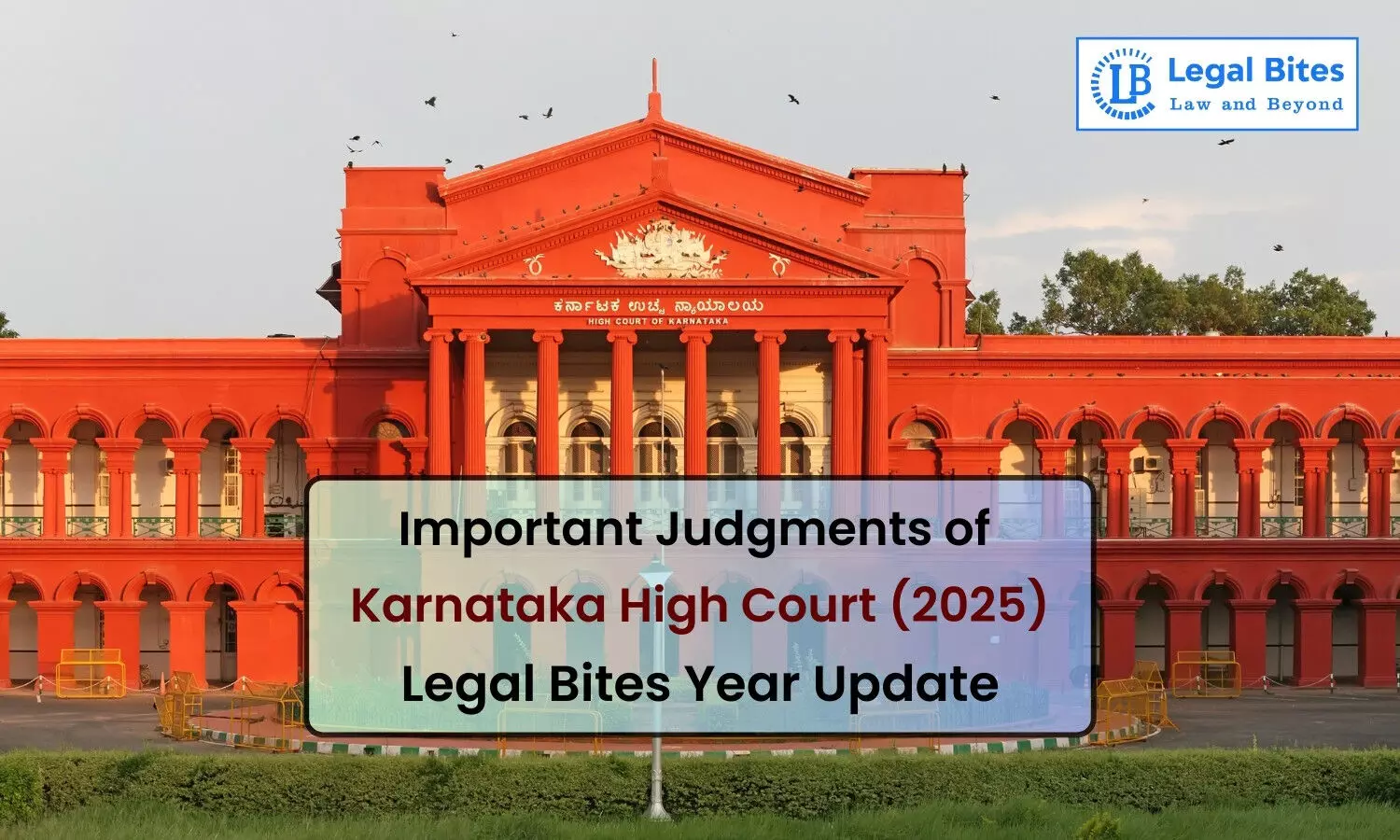
Legal Bites brings together notable Karnataka High Court judgments from 2025 that illuminate how the judiciary is responding to changing social realities and legal complexities. Addressing issues ranging from crimes against women and child protection to service benefits, religious inclusivity, and senior citizens’ welfare, these decisions offer valuable insight into contemporary judicial thinking.
Important Judgments of Karnataka High Court (2025)
Legal Bites Year Update
Legal Bites Year Update
1) Abusive Messages Alone Do Not Amount to Stalking
The Karnataka High Court in Abhishek Mishra v. State of Karnataka & Anr. (2025), held that merely sending abusive or threatening messages, by itself, does not constitute the offence of stalking under Section 354-D IPC (now Section 78 BNS). The Court clarified that stalking requires a pattern of repeated, unwanted conduct coupled with an intention to pursue personal interaction despite clear disinterest. While such messages may attract liability under other provisions like criminal intimidation, intentional insult, voyeurism, or violation of privacy under the IT Act, they do not automatically satisfy the statutory ingredients of stalking.
2) Women Can Be Prosecuted for Penetrative Sexual Assault Under POCSO
The Karnataka High Court in Smt. Archana Patil v. State of Karnataka & Anr. (2025), authoritatively held that the Protection of Children from Sexual Offences Act, 2012 is a gender-neutral statute and that women can be prosecuted for penetrative and aggravated penetrative sexual assault under Sections 4 and 6 of the Act. Rejecting the argument that the use of the pronoun “he” in Section 3 restricts liability only to male offenders, the Court relied on Section 8 of the IPC [now Section 2(10) of BNS], legislative intent, and the 2019 POCSO amendment to conclude that “he” includes persons of any gender.
3) Parole Cannot Be Denied for Not Seeking Bail or Suspension of Sentence
The Karnataka High Court, in Eshwaramma v. State of Karnataka (2025), held that a convict cannot be denied parole merely because he has not applied for bail or suspension of sentence in a pending criminal appeal. Clarifying the distinction, the Court observed that parole is a temporary, humanitarian release governed by prison rules and is conceptually different from bail or suspension of sentence, which are judicial remedies granting release for the duration of the appeal.
4) Muslim Inheritance and Uniform Civil Code
The Karnataka High Court in Samiulla Khan & Ors. v. Sirajuddin Macci (2025), held that the spouses jointly acquired properties purchased during the subsistence of marriage. On the wife’s intestate death, only her 50% share could devolve under Muslim Personal Law. Applying Sunni Hanafi principles, the Court awarded the husband a dominant 3/4th share overall, with the brothers and sister receiving proportionately lesser shares.
5) Interfaith Participation in Religious Festivals is Constitutionally Permissible
The Karnataka High Court, in H.S. Gaurav v. State of Karnataka & Ors. (2025), held that inviting a person belonging to another faith to participate in a religious or cultural festival does not violate Articles 25 or 26 of the Constitution. The Court ruled that the State-sponsored Dasara inauguration at the Chamundeshwari Temple was a cultural event, and the presence of a Muslim author as Chief Guest was symbolic and inclusive, causing no interference with anyone’s freedom of religion or denominational rights.
6) Medical Reimbursement Cannot Be Denied Due to Hospital Name Change
The Karnataka High Court, in Dr. Shivanandappa Doddagoudar v. State of Karnataka & Ors. (2025), held that medical reimbursement to a government servant cannot be denied merely because the hospital where treatment was taken changed its name. Justice Suraj Govindaraj ruled that Kasturba Hospital, Manipal, was a continuation of the earlier recognised Kasturba Medical College Hospital, Manipal, and that denial of reimbursement based on nomenclature differences was arbitrary and legally unsustainable.
7) No Leniency in Crime Against Women
The Karnataka High Court, in Syed Parveez Musharaff v. State of Karnataka (2025), refused bail to an accused charged with facilitating rape, holding that restraining the victim’s cousin to enable the offence amounted to active participation. Justice S. Rachaiah observed that crimes against women leave lifelong scars and require a strict approach at the bail stage, where individual liberty must be balanced against societal interest.
By invoking a Manusmriti shloka and Mahatma Gandhi’s words, the Court reaffirmed that protecting women’s dignity is central to constitutional morality and social progress, and that leniency would erode public confidence in justice.
8) Protection of Senior Citizens Justifies Eviction Orders
The Karnataka High Court (Dharwad Bench), in Smt. Soumya v. Smt. Ratnakumari & Ors. (2025), upheld the power of the Senior Citizens Tribunal to order eviction when necessary to secure the safety, dignity, and welfare of elderly persons under the Maintenance and Welfare of Parents and Senior Citizens Act, 2007. Dismissing the daughter-in-law’s challenge to an eviction order, Justice M. Nagaprasanna held that the Tribunal’s authority includes incidental and implied powers to restore possession and prevent harassment, even if eviction is not expressly mentioned in the statute.
Important Link