
Key Features of Budget 2026–2027
Key highlights of India Budget 2026–27 covering manufacturing, infrastructure, tax reforms, MSMEs, services, and fiscal roadmap toward Viksit Bharat.
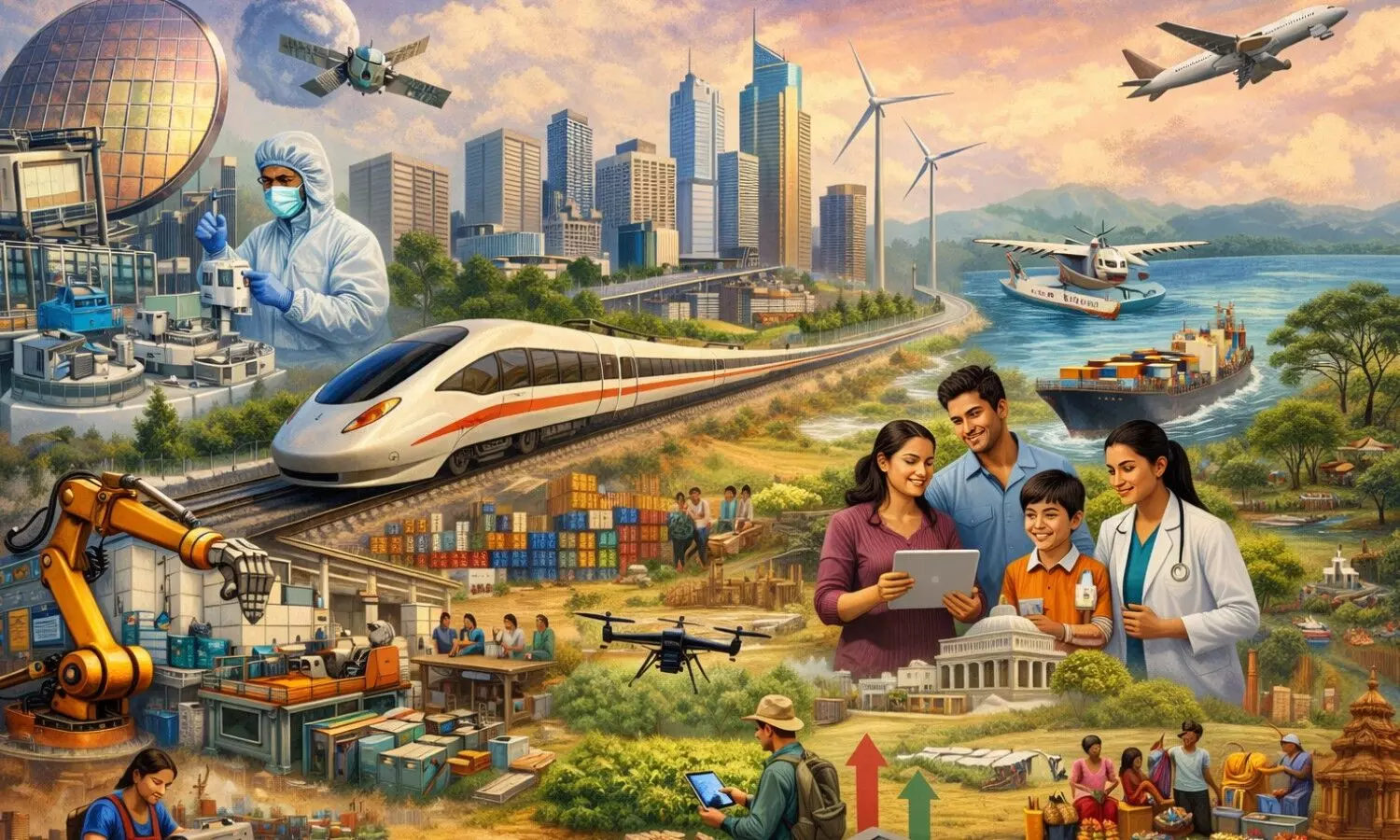
The Union Budget 2026–27 presents a forward-looking roadmap aimed at transforming India into a Viksit Bharat through balanced growth, social inclusion, and structural reforms. The Budget emphasises people over populism, reform over rhetoric, and action over ambivalence, ensuring macroeconomic stability while nurturing domestic capabilities. It targets sustained growth of around 7 percent, moderate inflation, fiscal discipline, and energy security.
Download the official PDF of Key Highlights
I. Vision and Strategic Priorities
The Budget is driven by a Yuva-Shakti-oriented approach, focusing on:
- Accelerating Economic Growth – through enhanced productivity and competitiveness.
- Building People’s Capacity – empowering citizens as partners in prosperity.
- Inclusive Development – ensuring access to resources across regions and communities.
More than 350 reforms have been introduced, including GST simplification, labour code notifications, and rationalisation of Quality Control Orders. High-level committees and Centre–State coordination are being strengthened for deregulation and compliance reduction.
II. Sustaining Economic Growth
1. Manufacturing – Strategic & Frontier Sectors
The Budget aims to make India a global manufacturing hub by:
- Reviving 200 legacy industrial clusters
- Launching India Semiconductor Mission 2.0
- Establishing Electronics Components Manufacturing Scheme
- Creating 3 Dedicated Chemical Parks
- Promoting Biopharma SHAKTI
- Initiating schemes for rare earth magnets, container manufacturing, affordable sports goods, and hi-tech tool rooms.
Tax Incentives for Manufacturing
- 5-year income tax exemption for non-residents providing capital goods in bonded zones.
- Safe harbour provisions for warehousing.
- Duty-free imports for seafood processing increased from 1% to 3%.
- Extension of export timelines from 6 months to 1 year for leather/textile exporters.
- BCD exemption for aircraft, microwave, and defence components.
- Electronic sealing for export cargo.
2. MSME Growth as ‘Champions’
- A three-pronged MSME strategy includes:
- ₹10,000 crore SME Growth Fund
- ₹2,000 crore top-up to Self-Reliant India Fund
- Mandatory use of the TReDS platform by CPSEs
- Credit guarantee through CGTMSE
- Linking GeM with TReDS
- Development of Corporate Mitras for compliance support
Courier export cap of ₹10 lakh removed.
3. Services Sector Push
Key initiatives:
- Five Medical Value Tourism hubs
- 1.5 lakh multiskilled caregivers
- AVGC labs in 15,000 schools & 500 colleges
- National Institute of Design (eastern region)
- Khelo India Mission expansion
Tax Measures
- IT services safe harbour margin at 15.5%
- Threshold raised from ₹300 crore to ₹2,000 crore
- 5-year tax holiday for foreign cloud providers
- Buddhist circuit and eco-tourism promotion
4. Agriculture & Allied Sectors
- Development of 500 reservoirs & Amrit Sarovars
- Cashew, cocoa, sandalwood programmes
- AI-enabled Bharat VISTAAR via AgriStack
- Capital subsidy for veterinary infrastructure
- Fisheries value chain and FPO support
III. Strengthening Foundations of Growth
1. Infrastructure
- Infrastructure Risk Guarantee Fund
- New freight corridors: Dankuni–Surat
- 20 new national waterways
- Coastal Cargo Scheme
- Seaplane VGF
- ₹2 lakh crore to States under SASCI
- Public capex rising from ₹2 lakh crore (FY15) to ₹12.2 lakh crore (FY27)
2. Energy Security
- ₹20,000 crore CCUS scheme
- BCD exemption for lithium-ion cell equipment
- Duty relief for nuclear projects till 2035
- Biogas excise exclusion
3. Urbanisation
- Focus on Tier-II/III cities
- 7 High-speed rail corridors, including Mumbai–Pune, Hyderabad–Bengaluru
- City Economic Regions model.
IV. People-Centric Development
- Care ecosystem with 1.5 lakh caregivers
- SHE Marts for women SHGs
- Divyang Kaushal & Sahara Yojanas
- ALIMCO expansion
- NIMHANS-2 and trauma centres
V. Trust-Based Governance
- AEO duty deferral from 15 to 30 days
- Advance ruling validity to 5 years
- Automated customs notifications
- Warehouse operator-centric system
VI. Ease of Doing Business & Living
Major tax simplifications:
- TCS on foreign tours cut to 2%
- TDS rationalisation
- Extended return revision till 31 March
- Foreign asset disclosure scheme
- MAT exemption for presumptive taxpayers
- Cancer drug duty exemption
- Digital cargo clearance
VII. Fiscal Framework
- Fiscal deficit: 4.3% of GDP (2026–27 BE)
- Debt-GDP target: 50±1% by 2030
- Vertical devolution retained at 41%
- ₹1.4 lakh crore Finance Commission grants
Receipts & Expenditure Highlights
Major spending:
- Transport ₹5,98,520 cr
- Defence ₹5,94,585 cr
- Rural Development ₹2,73,108 cr
Conclusion
Budget 2026–2027 is a transformational blueprint, blending technology, inclusion, and investment to propel India toward developed-nation status. With emphasis on youth, manufacturing, services, and fiscal discipline, it lays the foundation for resilient and equitable growth. The Budget not only responds to present challenges but also prepares India for a future defined by innovation, sustainability, and opportunity.
Important Link
Law Library: Notes and Study Material for LLB, LLM, Judiciary, and Entrance Exams